Endeavour Foundation acknowledges the Traditional Custodians of Australia and their continuing connections to land, sea, and community. We pay our respects to Elders past, present, and emerging and extend that respect to all Aboriginal and Torres Strait Islander peoples today.
Endeavour Foundation and Community Solutions Group (CSG) embrace the importance of reconciliation and the significant role we can play in it. We are committed to increasing opportunities and improving outcomes for Aboriginal and Torres Strait Islander individuals, families and communities.
Our journey towards reconciliation is based on facilitating and participating in activities that confirm and display our commitment to reconciliation.
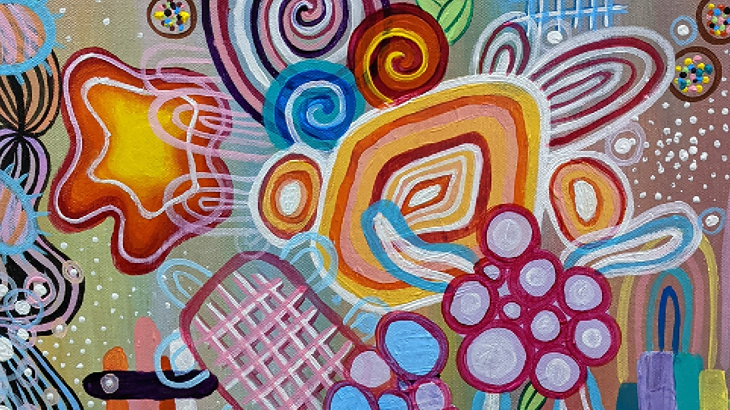

I have used modern bright pastel colours to lighten the mood. I wanted it to represent fun and give you happiness when you look at it. The intention is to create a feeling of happiness, growth and hope. I also wanted it to connect to the land too. For me, the land gives me joy
Reconciliation Australia formally endorses our Reflect Reconciliation Action Plan (RAP).
Our Vision
Our Reflect RAP is the start of a structured approach making our organisation culturally safe for our employees and the people we support – and reflects and embraces our mission and core values – ONE, CARE, PASSIONATE, INNOVATE
Our Goal
Through our REFLECT Reconciliation Action Plan (RAP) 2021–22 we commit to creating a culturally inclusive and safe environment in support of Aboriginal and Torres Strait Islander peoples in our communities, based on mutual respect.
Welcome to & Acknowledgment of Country
The difference between Acknowledgement to Country and Welcome to Country
Wherever you are in Australia, you’re on Aboriginal and Torres Strait Islander land:
Acknowledgement of Country is all about RESPECT
It’s an opportunity for anyone to acknowledge and pay respect to First Nations peoples as the Traditional Owners and ongoing custodians of the land. Acknowledgements are often made at the start of an event – such as a meeting, speech or formal occasion. They can also be written – such as on an email, website or sign.
“This is a spiritual verse for me. To hear it is to hear the words/prayers with meaning, heart and purpose. Feel it. Say it. Be it. Words have power and for you to put your energy [into an Acknowledgement of Country] means you need to feel them. If not don’t say it because if you don’t mean it, it has no worth and it will show… For me, it unites us all.” — Yugambeh Site Manager, Julie Lyons
Birri Gubba singer, songwriter and multi-instrumentalist, Waveney Yasso visited Kingston L&L hub during NAIDOC Week and gave a captivating performance of “Mother Earth” – a song she co-wrote to pay respect to the Elders and the Traditional Owners of the land.
Welcome to Country is delivered by Traditional Owners, or Aboriginal and Torres Strait Islander peoples who have been given permission from Traditional Owners, to welcome visitors to their Country.
“A Welcome to Country is like if you’re hosting a birthday: you do a welcome and say thank you for coming to my birthday. An Acknowledge of Country is like if you’re a guest at the birthday: you would say thank you for having me.” — Bangerang man, Scott Kneebone
2022 Important Dates
On 26 May, we observe National Sorry Day, a day to acknowledge the history and continued effect of the forced removal of Aboriginal and Torres Strait Islander people from their families, communities and culture.
This date carries great significance for the Stolen Generations and other Aboriginal and Torres Strait Islander peoples, and is also commemorated by people right around the country.
I encourage you to get involved in this significant day by finding and attending a local event, or observing it at your site with a morning tea, a Sorry Day flag raising ceremony, or inviting an Elder or community leader to your site. I hope everyone will take a moment to recognise National Sorry Day and the Stolen Generations on 26 May. By recognising the wrongs of the past, we continue forwards on our journey to reconciliation and acknowledge the significant role we play in it.
– David Swain
2022 National Reconciliation Week (NRW) (27 May – 3 June) was a time for us to reflect on what we can do to advance reconciliation across the organisation. This year’s theme, ‘Be Brave. Make Change.’ encouraged staff to dig deep, stay motivated and use the tools and education available to be brave and make positive changes to their workplace to be inclusive and culturally safe. A themed message was sent to all staff every business day throughout the week to spread awareness, encourage action and share stories from First Nations employees and non-Indigenous allies. Revisit content from 2022 National Reconciliation Week.
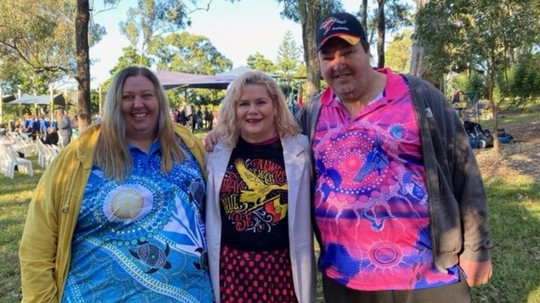
NAIDOC Week celebrates Indigenous culture and heritage, commemorates 65,000 years of history, unifies communities, and is day to educate and share stories. This year’s theme was ‘Get up! Stand up! Show up!’ – a call for action to bring about systemic change within our communities. RAP Working Group members Joanne Leonard (Site Supervisor), Kirsty Watson (Enterprise Risk Advisor) and Danielle Eyre (Corporate Communications Advisor) shared what motivated them to stand up for reconciliation and encourage their colleagues to celebrate NAIDOC week alongside them.
Birri Gubba singer, songwriter and multi-instrumentalist, Waveney Yasso also visited Kingston L&L hub during the week and gave a captivating performance of “Mother Earth” – a song she co-wrote to pay respect to the Elders and the Traditional Owners of the land.
Read the full NAIDOC week article (3 mins).
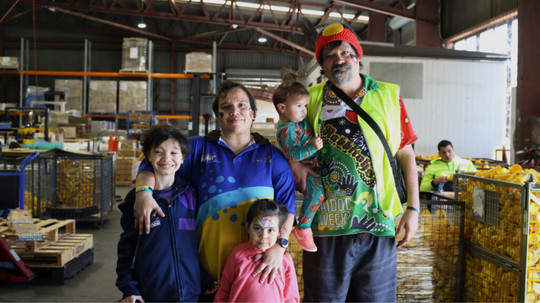
The International Day of the World’s Indigenous Peoples is observed on 9 August each year to promote and protect the rights of First Nations peoples around the world. On this meaningful day, we introduced staff to Business Solutions Geebung First Nations employees, Rowan Boyd, Chris Everingham and Liz Burke. They – along with the help of staff and other First Nations employees – organised an inclusive event to share their cultures and spark conversations about reconciliation.
Frequently Asked Questions (FAQs)
Yes
You can also download Mya’s artwork on your computer, then update your Zoom or Teams background when in a meeting. Follow instructions below:
Microsoft Teams
Change your background before a meeting starts
- While you’re setting up your video and audio before joining a meeting, select Background filters.

It’s just below the video image. Your background options will display on the right. - You can also replace your background with one of the images provided, or with one of your own choosing. To use an image of your own, select Add new and then select one to upload from your computer.
Make sure it’s a .JPG, .PNG, or .BMP file.
Your new background will persist in all your meetings and calls until you change it again.
To turn off background effects, select 
Zoom
How to apply a Virtual Background
- Sign in to the Zoom desktop client.
- Click your profile picture, then click Settings.
- Select Backgrounds & Filters (Note: If you do not have the Virtual Background tab and you have enabled it on the web portal, sign out of the Zoom desktop client and sign in again.)
- Check I have a green screen if you have a physical green screen set up. You can then click on your video to select the correct color for the green screen..
- OR add your own image or our RAP background by clicking and choosing if you want to upload an image or a video. If prompted, click Download to download the package for virtual background without a green screen.
- Notes:
- To disable Virtual Background, open the virtual background options again and choose the option None.
- Ensure that you are using a solid background color when I have a green screen is checked.
- After you select an option, that virtual background will be used for your future meetings.
- For more information about the Blur option, please refer to the Blurred background article.
- If your account admin set a default virtual background, they can also enabled it to reset back to the default if you changed your virtual background during a meeting.
We are committed to reconciliation and improving the knowledge, skills and abilities required to be a culturally safe organisation for Aboriginal and Torres Strait Islander peoples in our communities.
Our journey towards reconciliation relies on creating a culturally safe environment with strong relationships based on mutual respect.
Executive General Manager – People and Culture, Shannon Richards, has accepted the role of Project Champion for the Reflect RAP working group.
Members are invited to participate and contribute to our reconciliation outcomes. They:
- advise on RAP processes and activities
- assist in building awareness
- help guide the progression of our RAP.
Yes. There is an open invitation to all staff to join the working group at any time, including supported employees.
We are looking for a diverse range of staff to join this working group representing a variety of roles, services and locations.
No experience is required. Although a passion for supporting, encouraging and fostering improved experiences for Aboriginal and Torres Strait Islander people is necessary.
It’s easy! Just email [email protected].
The views and guidance of Aboriginal and Torres Strait Islander staff is critical to ensure the success of the working group and our reconciliation journey.
The working group actively seeks the views of Aboriginal and Torres Strait Islander representatives.
We welcome Aboriginal and Torres Strait Islander staff to join the working group at any time, including supported employees.
ABC News did a feature last year to help teach people about Indigenous languages and have an interactive map that is a permanent feature on their website. The map also notes the meaning of the names.
Mya’s design will be incorporated in lanyards for staff to wear, email signatures blocks and Acknowledgement of Country cards to use at the beginning of meetings and gatherings with your team.
We would love to hear your ideas and thoughts on how we can strengthen relationships on our journey towards reconciliation.
Please email your feedback or questions to [email protected]
Supply Nation
We are accredited members of Supply Nation, Australia’s leading database to over 3,900 verified Aboriginal and Torres Strait Islander businesses throughout Australia.
Supporting Indigenous suppliers is one way you can create positive social change and sustainable supplier diversity.
If you are looking for suppliers, perhaps for an event you may be hosting, why not check Supply Nation first? This is the most assured way of choosing verified Aboriginal and Torres Strait Islander suppliers.
Please remember to follow our Procurement Policies when selecting new suppliers.
For more information on setting up a new supplier, you can read through these Frequently Asked Questions.
If you have any questions about choosing Aboriginal and Torres Strait Islander suppliers, feel free to reach out to the Procurement team at [email protected] who are happy to answer any of your questions.
RAP Working Group
The RAP Working Group meet on a fortnightly basis. If you are interested in finding out more information about our RAP or becoming a Working Group member, speak to a member of the Working Group or email [email protected].
